Showing posts with label antique rosaries. Show all posts

Wednesday, February 8, 2012

A Celebration of Beautiful Red Rosaries

I thought this month would be a fine time to share the great variety of beautiful red beads used in antique rosaries. Many Victorian aged rosaries have the deep red glass beads made to resemble garnets, while others of this time are accented with gorgeous and rare natural Mediterranean coral that has a more salmon tone. There are even antique beads composed of a man-made material called bois durci that used sawdust and various other materials. The story goes that the reddish color of these beads is from the addition of blood as a binder.


Although at Valentine's Day and other times throughout the year, red symbolizes love, it can also symbolize blood and even war. This is not the case with rosaries, though, as red rosaries were produced primarily for aesthetic purposes- some people prefer colored beads rather than wood beads. There are rare chaplets where the color red symbolizes the blood of Christ- such as the The Precious Blood chaplet.


Enjoy these stunning red antique rosaries in a variety of materials- all found on The Sacred Bead. I also added some lovely Mother of Pearl rosaries to provide a contrast to the red. The incredible way that MOP catches the light is a wonder for the eyes.

 Extremely rare carnelian beads with sterling- antique French rosary from the mid-1800s.
 Beautiful rosary from Lourdes France with faceted red glass beads.
 Victorian Era Red Glass Rosary.
 Precious Mediterranean natural sea coral and mother of pearl rosary. Coral was believed to have protective qualities and was extremely popular during the Victorian period.
 1800s rosary with bois durci beads.
 A fabulous 1800s very large Mother of Pearl Rosary with MOP and silver crucifix.
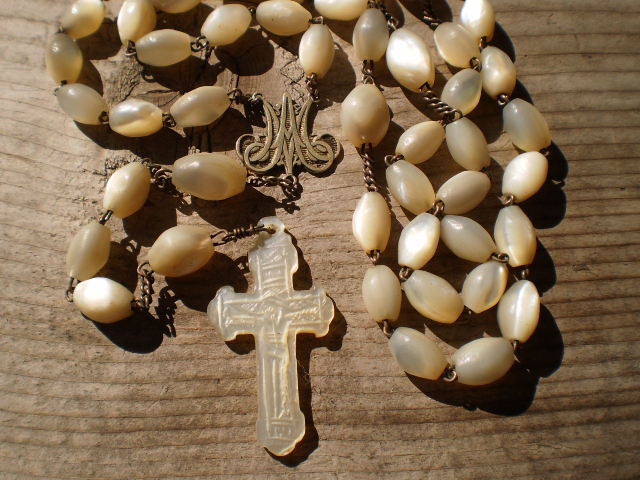
 Mother of Pearl with a warmer tone- beautiful hand cut beads and a delicate fleur de lis crucifix
 Lovely garnet colored glass beads on a sweet, antique rosary.
 Mother of Pearl Cross- quite rare!
Fabulous garnet colored cut glass with incredibly detailed sterling crucifix and center- a stunning rosary from the 1800s.
 Beautiful French antique rosary with natural coral beads.
 These are deep red glass Prosser beads- an inventive new type of bead made in a mold and used extensively as trade beads.
 Gorgeous strung Bavarian rosary with opaque glass beads that resemble coral.
 Sweet 1800s hand cut mother of pearl rosary with MOP center and cross.
Very unusual bright red 1800s antique rosary with Prosser beads and the original old brass case. Could have accompanied pioneers as they headed west.

Sunday, November 6, 2011

Exquisite Bavarian Six Decade Filigree Rosary

Antique Bavarian rosaries are some of the most incredible rosaries ever produced and are highly collectible. They are unique to this region of Germany, and what truly sets them apart is the gorgeous filigree silverwork. (I have seen silver filigree work called spun silver by some antique and vintage jewelry dealers.)
These are generally strung rosaries, although some of them are linked. They have been produced for hundreds of years and are still produced in much the same manner today. Note the distinctive crucifix of filigree with an inlaid enameled cross set into the silver. Bavarian rosaries from the 1700s and early 1800s sometimes have a simple inset cross made of wood and mother of pearl. This rosary most likely dates from the late 1800s. Above the large cross, you'll almost always find a Credo cross, smaller and simpler in design. Although many of the rosaries are five decades, most are six. Over the years, these rosaries are strung and resturng- so the age cannot be determined by the stinging material. Beads also get replaced as the rosaries break and beads are lost- it is quite common to find slightly mismatched beads making up part of the rosary. The tiny spacer beads between each Ave bead are also commonly replaced after a rosary breaks and many of the tiny beads are lost. The German word for rosary is rosenkranz, and it does not refer simply to Bavarian rosaries, rather all rosaries. Using the word does not mean the rosary is old or new, simply German. Just as chapelet is the French word for rosary, whether antique or modern.
This beautiful rosary can be found on Antiques page 12 on The Sacred Bead. Antique Bavarian rosaries are increasingly difficult to find and are true, high-end collector rosaries. (This beautiful rosary is now in a private collection.)

 Main filigree cross with inset enameled cross, note the smaller Credo cross above and the little dangle at the bottom of the main cross.
 Six decades with filigree Pater beads.
 Exceptional filigree work!

Sunday, October 16, 2011

Two Mystery Rosaries

I have two rosaries, one on The Sacred Bead and another that a reader sent me pictures of that I could use a little assistance with! 
The first rosary is an absolutely beautiful art glass rosary from Italy. It is the beads that have me intrigued. Although I am a decades long bead collector and have a pretty vast knowledge of antique beads, I have never seen this particular bead before. It reminds me of saphiret beads in the way that the colors come from inside the beads. There is no coating on the outside, as in Aurora Borealis beads, rather the glow or flashes of color come from the inside. Saphiret beads were made with actual gold in the glass, so I am guessing a process similar to that produced these beads. When held to the light the Ave beads have a golden or yellow glow, while the Pater beads have a pinkish flash of color. From the style of the center, I am estimating that this rosary is from the middle of the 20th century. The rosary is for sale on The Sacred Bead on Antiques Page 7. If anyone knows the name of these beads, where they were made, or how they were made, I'd love to know!

 Note how each Ave bead is wirewapped and the larger round Pater beads have caps. Lovely, lovely rosary!


The second rosary is very similar to a WWI soldier rosary with pull chain style beads. There are three major differences though. The standard WWI rosaries are between 16 and 17 inches when laid flat, this rosary is 18 inches long. It has a different center- all the WWI rosaries have the same center with Mary on one side and Jesus carrying the cross on the reverse. The most significant difference is the shape of the beads. Rather than being round, the Ave beads are oval!  If anyone has any knowledge about rosaries like this I would certainly appreciate hearing from you- just go to The Sacred Bead and email me please. Thanks so much in advance for any help you can give!
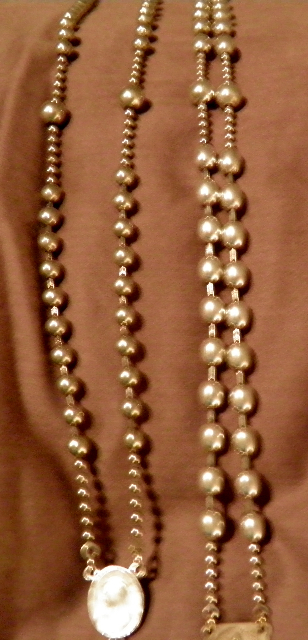
 The rosary on the left is a WWI rosary, note the oval shaped beads on the mystery rosary on the right.
 On the left is the center always found on the WWI rosaries. Note how the construction of the connectors is identical in both rosaries.

Wednesday, July 6, 2011

Antique and Vintage Rosaries With Spina Christi Beads- Are They Real or Plastic?

 Here are two vintage rosaries made of spina Christi beads, the seeds from a thorny plant said to be what Christ's Crown of Thorns was made of. Most information points to these beads being from the Zizyphus spina-christi plant, native to the Middle East. But, one rosary is made from the actual seeds, while the other is made of plastic beads produced to resemble spina Christi beads. Can you tell which is which?


 The beads on the left are real, while the ones on the right are plastic. The biggest clue is the uniformity of the shape of the plastic beads. Looking closely (but not shown in the pictures), you can see a little line from the mold that the beads were formed in running along the outside of each bead. Compare the variations in color in the beads on the left, the richer shine and the difference in shapes. The holes in plastic beads will always be right at the top and bottom of the beads, whereas the holes in the actual seeds may be a little off center.
Another clue is the plastic beads will lay perfectly flat. The variations in the size and shape of the real beads generally prevent them from all laying flat.
 Here they are jumbled together- can you see the difference now?


Another clue might be the age of the rosary based on materials. The center of the real seed rosary is an old Art Deco style and you can see the brass beneath the silver plating. The center on the right is made of some kind of white metal, possibly pewter, commonly used in the last half of the 20th century. Although, dating a rosary does not guarantee it has authentic spina Christi beads, generally, the older the rosary, the more likely the seeds will be real.
Hopefully, this will help you in your rosary collecting. Remember, there really is nothing wrong with plastic, although, I must admit, I have a real aversion to it!
Find a wonderful selection of antique and vintage rosaries on The Sacred Bead. I am always very careful with describing rosaries, their age and what they are made of. If I don't know or am not sure, I'll always state that.

Sunday, April 24, 2011

Gorgeous Vintage Virgin of Guadalupe Rosary

This is such a special rosary with beautiful encased glass beads and a magnificent crucifix. Dating from the middle of the 20th century,  Our Lady of Guadalupe is featured on both the crucifix and reverse of the center. I'll let the pictures speak for themselves.
 Simply gorgeous crucifix with The Virgin of Guadalupe at the top.

 Lovely double capped, or encased, glass beads.

Our Lady of Guadalupe on the reverse of the center. See this wonderful rosary on The Sacred Bead.
It is told that the Virgin of Guadalupe appeared to the Aztec man Juan Diego on December 9, 1531 and again later when her image miraculously formed on his tilma or cape. He had gathered flowers from the hillside in the dead of winter at her direction in order to show the Bishop proof of his vision of the Virgin. She told him not to open the cape full of flowers until he was with the Bishop and when he arrived, low and behold, the flowers dropped to the floor and the famous image of the Virgin took their place on his cape. The Virgin of Guadalupe is called the Patroness of the Americas and is one of the most beloved images of the Virgin Mary.  Juan Diego was canonized in 2002.

Saturday, February 19, 2011

Religious Medals on Antique Rosaries

Frequently, rosaries from the French influenced areas of Canada and throughout Europe have a variety of religious medals attached. Dating back centuries, the practice of attaching medals obtained during various religious pilgrimages proliferated in Europe and continues to today. Enjoy some pictures of antique rosaries with attached medals from Canada and Europe that are currently on The Sacred Bead. The Miraculous Medal is, without a doubt, the most commonly added medal found on rosaries.
Note the use of antique aluminum medals on this 15 decade antique rosary.
An Irish Horn rosary with an attached Miraculous Medal.
Art glass beads and a beautiful blue enamel medal of Mary grace this exquisite antique rosary.


An exceptional 15 decade rosary from a convent in Belgium. Note the carved skull bead on the rosary. Now in a private collection.
This incredible bronze medal of St. Franscis is on a Fransiscan Crown rosary also in a private collection.
Lovely crystal and sterling rosary with several pretty medals attached.

Sunday, December 12, 2010

The 1800s Aluminum Story

Although aluminum is viewed as a cheap metal today, one that is virtually tossed away with the garbage, this hasn't always been the case. Collectors of antiques have some appreciation for the change in this metal's status over the centuries. Despite this, there is little market for aluminum objects, even those of superior workmanship and beauty.


If you read The Lost Symbol, you may have noticed the rather odd references to the high value of aluminum in the 1800s. This honestly was the case. Aluminum was a new and unique metal, durable, lightweight, and resistant to tarnishing. At the time, it was considered quite rare and valuable. The very top of the Washington Monument is overlaid in aluminum; it catches the sunlight and shines like silver. Although it is the most common element in the rocks of the earth, efficiently extracting it from the ore was puzzling and expensive, prohibiting its mining and use. Unlike silver and gold that occur in veins, aluminum is bonded to other elements in the rock, making extraction difficult.


For rosaries and religious medals, aluminum was highly prized during the late 1800s. Medals were lightweight and could be made with details not possible with other materials. Centers and crucifixes were made of aluminum in the late 1800s and early 1900s. Today they aren't appreciated, but at the time, their intricate details were considered the latest technology and were quite desirable. Many antique rosaries have aluminum medals attached; they were prized for their beauty.


Collectors of religious medals can get fantastic bargains if they branch into antique aluminum medals. Owners and collectors of antique rosaries can gain a new appreciation for the metal when they consider how impressive it was at the time the rosary was created.


I rarely have aluminum medals or rosaries on my website; I am aware of the prejudice against the metal and how it affects the choices collectors make. I'd like to see the day when it is recognized for its historic value and appreciated for the role it played in advancing the technology of 19th century religious artifacts.


 Sweet little French rosary with coral red glass beads. Below is a Pocket Saint with brass case, the statue of Mary and Child is aluminum. These were treasured by soldiers and travelers as they could be kept safely in a pocket.


The two medals attached to this lovely old Irish Horn rosary are both aluminum. Note the crisp detail on the medals. Available on The Sacred Bead.
 This is a lovely example of an antique French rosary with aluminum crucifix and art glass beads. It is quite a bargain on The Sacred Bead!

Monday, November 1, 2010

Czech Art Glass Beads on Antique Rosaries

 Beautiful blue beads with a bit of iridescence; each has a cross image inside the glass. Superb example of the skill of Czech bead makers.
 Antique French rosary with extra medals and delightfully subtle caramel colored, molded glass beads.
 Incredible deep caramel color swirled Czech glass beads adorn this antique rosary at The Sacred Bead.


 Lovely violet and pink beads.
Exceptional Czech art glass beads made to resemble precious tiger eye. These beads fool many who think they are natural stone rather than glass.
 Beads are in the shape of roses- just lovely combined with the enamel work and extra medals between each decade.
 This type of bead was made to resemble natural gemstones- many owners and sellers of these rosaries do not realize that these are art glass beads and believe they are natural stone. They were produced in a wide range of colors to mimic tiger eye, carnelian, and agate. The clue is the light band around the equator of each bead- natural stone will not have that. Absolutely gorgeous beads! If you are thinking about buying an antique rosary, find an exceptional number of beautiful antique rosaries in all price ranges on The Sacred Bead.
Czech bead makers have been masters of interesting beads, molded beads that resemble everything from cats to roses, and art glass beads with swirling colors. Long established as a source of glass beads, Czech beads were a popular trade item to Africa and Asia. Beads resembling coral, agate, and amber were highly regarded by those who couldn't afford the real material.
Antique French rosaries often have Czech beads as they are beautiful and were not overly expensive. Fine bead stores today have a multitude of interesting Czech beads- it is interesting to see that many bead makers are still producing the same beads that they were 100 years ago!