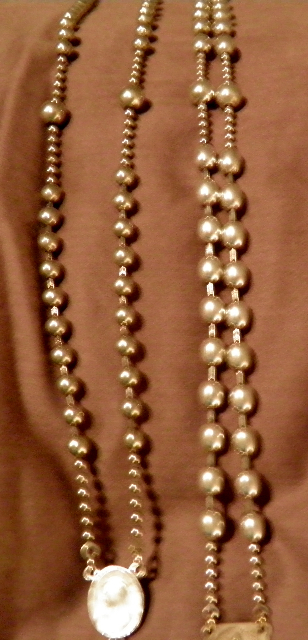
I have been so busy I have been neglecting my blog! Just a quick note and a lot of pictures to show some the newest additions of antique and vintage rosaries to The Sacred Bead. There are plenty of moderately priced rosaries for you so enjoy looking. I know the economy is not so great right now, so I am concentrating on bringing my customers the best rosaries at affordable prices. I'll have more detailed blogs on interesting rosaries coming up in February.
Spina Christi bead rosary with reliquary crucifix. Soil from the Catacombs of Rome is inside the crucifix.
Gorgeous rosary with extra medals and fabulous silver 18th C crucifix (someone added this stunning and rare crucifix to the early 20th C rosary)
Pardon cross, early 20th C rosary with Czech Jesus beads.
Exquisite and Rare sterling and garnet glass mid 1800s antique French rosary. Both the center and crucifix are hollow silverwork- simply beautiful!
Beautiful double capped rosary, Italian.
Sweet blue WWI era rosary.
Stunning art glass and sterling rosary. The beads are Czech, faceted art glass- note the beautiful silver spacers on either side of the Pater beads.
Elegant and rare rosary that is simply lovely!
I will be covering many aspects of collecting antique rosaries in my blogs. Symbology, materials, origins, and other issues the antique rosary lover may be curious about will all be discussed. Each blog will feature a rosary from The Sacred Bead or a private collection. You can visit The Sacred Bead at www.thesacredbead.com
Tuesday, January 31, 2012
Sunday, January 15, 2012
An Extremely Rare Colored Civelli Rosary
This beautiful and quite rare Civelli rosary was spotted on eBay. The owner kindly gave me permission to share this incredible example of the well-loved Civelli rosaries with the world. I have tried to research when the colored versions were produced (the original patent does not mention color) and have had no luck so far. The original 1950 Holy Year issue had the Holy Spirit on the center rather than the Regina Pacis, Queen of Peace, center with relic soil from the Catacombs of Rome on the reverse. About 10 years ago I saw a bundle of colored Civellis offered for sale, and although I can't remember for sure, I believe there were orange and green ones also. These had come from a closed church- the priest apparently gave the rosaries as special gifts. Even the more common black and white Civellis have a range of colorings- some a warmer tone, while others are starkly black and white.
I also came across an interesting tidbit from a 1952 newspaper, just a little notice making people aware of the Civelli rosary. The cost was listed as $5!
Here are the pictures of this gorgeous red Civelli rosary. The rosary is in a private collection.
The reverse of the crucifix is similar to other later issue Civelli rosaries. The reverse of the 1950 Holy Year original version has a more detailed reverse complete with a shield.
Soil from the Catacombs of Rome in the reverse of the center. Even in the very worn Civellis, this little relic compartment is always intact. The tag below says Marque Depose which is the European version of registered trademark.
I also came across an interesting tidbit from a 1952 newspaper, just a little notice making people aware of the Civelli rosary. The cost was listed as $5!
Here are the pictures of this gorgeous red Civelli rosary. The rosary is in a private collection.
The reverse of the crucifix is similar to other later issue Civelli rosaries. The reverse of the 1950 Holy Year original version has a more detailed reverse complete with a shield.
Soil from the Catacombs of Rome in the reverse of the center. Even in the very worn Civellis, this little relic compartment is always intact. The tag below says Marque Depose which is the European version of registered trademark.
Sunday, November 6, 2011
Exquisite Bavarian Six Decade Filigree Rosary
Antique Bavarian rosaries are some of the most incredible rosaries ever produced and are highly collectible. They are unique to this region of Germany, and what truly sets them apart is the gorgeous filigree silverwork. (I have seen silver filigree work called spun silver by some antique and vintage jewelry dealers.)
These are generally strung rosaries, although some of them are linked. They have been produced for hundreds of years and are still produced in much the same manner today. Note the distinctive crucifix of filigree with an inlaid enameled cross set into the silver. Bavarian rosaries from the 1700s and early 1800s sometimes have a simple inset cross made of wood and mother of pearl. This rosary most likely dates from the late 1800s. Above the large cross, you'll almost always find a Credo cross, smaller and simpler in design. Although many of the rosaries are five decades, most are six. Over the years, these rosaries are strung and resturng- so the age cannot be determined by the stinging material. Beads also get replaced as the rosaries break and beads are lost- it is quite common to find slightly mismatched beads making up part of the rosary. The tiny spacer beads between each Ave bead are also commonly replaced after a rosary breaks and many of the tiny beads are lost. The German word for rosary is rosenkranz, and it does not refer simply to Bavarian rosaries, rather all rosaries. Using the word does not mean the rosary is old or new, simply German. Just as chapelet is the French word for rosary, whether antique or modern.
This beautiful rosary can be found on Antiques page 12 on The Sacred Bead. Antique Bavarian rosaries are increasingly difficult to find and are true, high-end collector rosaries. (This beautiful rosary is now in a private collection.)
Main filigree cross with inset enameled cross, note the smaller Credo cross above and the little dangle at the bottom of the main cross.
Six decades with filigree Pater beads.
Exceptional filigree work!
These are generally strung rosaries, although some of them are linked. They have been produced for hundreds of years and are still produced in much the same manner today. Note the distinctive crucifix of filigree with an inlaid enameled cross set into the silver. Bavarian rosaries from the 1700s and early 1800s sometimes have a simple inset cross made of wood and mother of pearl. This rosary most likely dates from the late 1800s. Above the large cross, you'll almost always find a Credo cross, smaller and simpler in design. Although many of the rosaries are five decades, most are six. Over the years, these rosaries are strung and resturng- so the age cannot be determined by the stinging material. Beads also get replaced as the rosaries break and beads are lost- it is quite common to find slightly mismatched beads making up part of the rosary. The tiny spacer beads between each Ave bead are also commonly replaced after a rosary breaks and many of the tiny beads are lost. The German word for rosary is rosenkranz, and it does not refer simply to Bavarian rosaries, rather all rosaries. Using the word does not mean the rosary is old or new, simply German. Just as chapelet is the French word for rosary, whether antique or modern.
This beautiful rosary can be found on Antiques page 12 on The Sacred Bead. Antique Bavarian rosaries are increasingly difficult to find and are true, high-end collector rosaries. (This beautiful rosary is now in a private collection.)
Main filigree cross with inset enameled cross, note the smaller Credo cross above and the little dangle at the bottom of the main cross.
Six decades with filigree Pater beads.
Exceptional filigree work!
Thursday, November 3, 2011
Special Pre-Holidays Sale for My Blog Readers!
In appreciation for all of my blog readers, I am running a Pre-Holiday Sale of 15% off any item at The Sacred Bead! To get your 15% off just follow these instructions.
- Visit The Sacred Bead.
- Email me while there- mention the blog special.
- State the Page Number and Title of the item you want.
- If you live in the US, I ship all items over $50 by insured, first class for free.
- International Customers- please tell me your location- I ship only by registered mail outside the US and must charge for this service.
- I'll email you in return and send you an invoice from Paypal with the discounted price.
- I'm happy to take US Postal Service money orders rather than Paypal- just let me know.
Sunday, October 16, 2011
Two Mystery Rosaries
I have two rosaries, one on The Sacred Bead and another that a reader sent me pictures of that I could use a little assistance with!
The first rosary is an absolutely beautiful art glass rosary from Italy. It is the beads that have me intrigued. Although I am a decades long bead collector and have a pretty vast knowledge of antique beads, I have never seen this particular bead before. It reminds me of saphiret beads in the way that the colors come from inside the beads. There is no coating on the outside, as in Aurora Borealis beads, rather the glow or flashes of color come from the inside. Saphiret beads were made with actual gold in the glass, so I am guessing a process similar to that produced these beads. When held to the light the Ave beads have a golden or yellow glow, while the Pater beads have a pinkish flash of color. From the style of the center, I am estimating that this rosary is from the middle of the 20th century. The rosary is for sale on The Sacred Bead on Antiques Page 7. If anyone knows the name of these beads, where they were made, or how they were made, I'd love to know!
Note how each Ave bead is wirewapped and the larger round Pater beads have caps. Lovely, lovely rosary!
The second rosary is very similar to a WWI soldier rosary with pull chain style beads. There are three major differences though. The standard WWI rosaries are between 16 and 17 inches when laid flat, this rosary is 18 inches long. It has a different center- all the WWI rosaries have the same center with Mary on one side and Jesus carrying the cross on the reverse. The most significant difference is the shape of the beads. Rather than being round, the Ave beads are oval! If anyone has any knowledge about rosaries like this I would certainly appreciate hearing from you- just go to The Sacred Bead and email me please. Thanks so much in advance for any help you can give!
The rosary on the left is a WWI rosary, note the oval shaped beads on the mystery rosary on the right.
On the left is the center always found on the WWI rosaries. Note how the construction of the connectors is identical in both rosaries.
The first rosary is an absolutely beautiful art glass rosary from Italy. It is the beads that have me intrigued. Although I am a decades long bead collector and have a pretty vast knowledge of antique beads, I have never seen this particular bead before. It reminds me of saphiret beads in the way that the colors come from inside the beads. There is no coating on the outside, as in Aurora Borealis beads, rather the glow or flashes of color come from the inside. Saphiret beads were made with actual gold in the glass, so I am guessing a process similar to that produced these beads. When held to the light the Ave beads have a golden or yellow glow, while the Pater beads have a pinkish flash of color. From the style of the center, I am estimating that this rosary is from the middle of the 20th century. The rosary is for sale on The Sacred Bead on Antiques Page 7. If anyone knows the name of these beads, where they were made, or how they were made, I'd love to know!
Note how each Ave bead is wirewapped and the larger round Pater beads have caps. Lovely, lovely rosary!
The second rosary is very similar to a WWI soldier rosary with pull chain style beads. There are three major differences though. The standard WWI rosaries are between 16 and 17 inches when laid flat, this rosary is 18 inches long. It has a different center- all the WWI rosaries have the same center with Mary on one side and Jesus carrying the cross on the reverse. The most significant difference is the shape of the beads. Rather than being round, the Ave beads are oval! If anyone has any knowledge about rosaries like this I would certainly appreciate hearing from you- just go to The Sacred Bead and email me please. Thanks so much in advance for any help you can give!
The rosary on the left is a WWI rosary, note the oval shaped beads on the mystery rosary on the right.
On the left is the center always found on the WWI rosaries. Note how the construction of the connectors is identical in both rosaries.
Sunday, October 9, 2011
Plenty of Moderately Priced Antique Rosaries on The Sacred Bead
As the Holiday Season approaches, many people are starting their search for just the right Christmas gifts. Antique and vintage rosaries make a fantastic gift for those who appreciate the exquisite craftsmanship and the beauty of rosaries that have been lovingly prayed on for decades.
With the economy as it is, I have been concentrating on bringing many more moderately priced rosaries to The Sacred Bead. You'll still find some incredible and rare rosaries, but also plenty to fit any budget! Here is just a sampling of the most recent additions to The Sacred Bead. Don't forget that buying an antique or vintage rosary is an ecologically sound choice. These rosaries already exist- you are saving energy and resources every time you purchase and antique or vintage item rather than a new one.
Lovely Faceted Crystal and Deep Blue Enamel Antique French Rosary. Antiques page 4
Fabulous Amethyst Crystal (glass that resembles amethyst) with Extra Medals Antiques page 20
Rare Handmade French Nun's Rosary from Quebec Antiques page 15
Incredible Italian Art Glass Rosary Antiques page 7
Lovely Antique French Rosary with Deep Garnet Glass Beads Antiques page 25
Art Deco Mother of Pearl Rosary with White Enamel Accents Antiques page 33
Antique French Rosary with Art Glass Beads and Extra Medals Antiques p 20
Beautiful Victorian Metal Rosary w Highly Detailed Crucifix Antiques page 21
Antique Rosary with Crystal Beads and Fancy Spacers Antiques page 10
With the economy as it is, I have been concentrating on bringing many more moderately priced rosaries to The Sacred Bead. You'll still find some incredible and rare rosaries, but also plenty to fit any budget! Here is just a sampling of the most recent additions to The Sacred Bead. Don't forget that buying an antique or vintage rosary is an ecologically sound choice. These rosaries already exist- you are saving energy and resources every time you purchase and antique or vintage item rather than a new one.
Lovely Faceted Crystal and Deep Blue Enamel Antique French Rosary. Antiques page 4
Fabulous Amethyst Crystal (glass that resembles amethyst) with Extra Medals Antiques page 20
Rare Handmade French Nun's Rosary from Quebec Antiques page 15
Incredible Italian Art Glass Rosary Antiques page 7
Lovely Antique French Rosary with Deep Garnet Glass Beads Antiques page 25
Art Deco Mother of Pearl Rosary with White Enamel Accents Antiques page 33
Antique French Rosary with Art Glass Beads and Extra Medals Antiques p 20
Beautiful Victorian Metal Rosary w Highly Detailed Crucifix Antiques page 21
Antique Rosary with Crystal Beads and Fancy Spacers Antiques page 10
Thursday, October 6, 2011
The Tradition of El Dia de Los Muertos
This whimsical image of a skeleton playing a guitar is one of many similar portrayals of skeletons enjoying life that are used during celebrations of the holiday , El Dia de los Muertos. Originating in Mexico but now found throughout the Americas, this holiday represents a blending of early Mexican celebrations and the new religion brought from Spain in the 16th century. All Saints and All Souls days fall roughly at the same time of year that the traditional Mexican festivities for the dead occurred, which explains why the holiday coincides with All Saints and All Souls days. As old customs were incorporated into the new religion brought by the Spaniards, El Dia de los Muertos became a time to both reflect on the meaning of life and to enjoy the presence of the ancestors. Rather than being a frightening symbol, the skeletons of this holiday are joyously represented.
Skulls on rosaries are an ancient tradition in Europe and are becoming increasingly well known and used in modern times. Many people appreciate the symbolism of both El Dia de los Muertos and rosaries with skulls. The skull on a rosary is a contemplative tool, reminding those in prayer of man's brief earthly life and Jesus' victory over death.
You can find the following rosaries on The Sacred Bead and The SacredBead2 on Etsy.
Antique inlaid crucifix, natural rust sponge coral and small carved bone skulls complete this interesting handmade rosary.
Large antique skull and crossbones crucifix, bone and resin amber beads and tiny carved bone skull beads makeup this intriguing rosary.
The center and crucifix are hand made bronze pieces, cast from antiques.
Unique skulls made of large seeds with gorgeous natural rust sponge coral beads highlight this lovely rosary.
Skulls on rosaries are an ancient tradition in Europe and are becoming increasingly well known and used in modern times. Many people appreciate the symbolism of both El Dia de los Muertos and rosaries with skulls. The skull on a rosary is a contemplative tool, reminding those in prayer of man's brief earthly life and Jesus' victory over death.
You can find the following rosaries on The Sacred Bead and The SacredBead2 on Etsy.
Antique inlaid crucifix, natural rust sponge coral and small carved bone skulls complete this interesting handmade rosary.
Large antique skull and crossbones crucifix, bone and resin amber beads and tiny carved bone skull beads makeup this intriguing rosary.
The center and crucifix are hand made bronze pieces, cast from antiques.
Unique skulls made of large seeds with gorgeous natural rust sponge coral beads highlight this lovely rosary.
Friday, September 16, 2011
An Antique Art Glass Rosary with Beads That Resemble Bloodstone
This is a lovely antique French rosary with magnificent art glass beads that very closely resemble the semi-precious gemstone, bloodstone or blood jasper. The beads and the stone are a deep mossy green with specks of red. Since the Middle Ages and possibly before, the stone was believed to contain drops of Jesus' blood. It is one of the ancient stones that people have long believed has healing and protective qualities. The beads on this rosary are so realistic looking, without having another antique rosary with actual bloodstone beads to compare it to, I might have been fooled!
European bead makers of the 18th and 19th centuries were masters of glass beads resembling gemstones. Garnet, lapis, agate, amethyst and coral beads were rare and expensive, so the glass bead artists developed very realistic beads at a greatly reduced price. Real jet was very rare, making French jet, the black glass that looks like jet, extremely popular for both rosaries and jewelry.
The simplest test to tell if something is a gemstone or glass (this works with quartz type stones- rock crystal (pure quartz), agate, amethyst, citrine, chalcedony etc. but not with jet, coral or other organic gemstones) is to compare the temperature of the stone beads with similar glass beads. The stone beads will always feel cooler to the touch. Other clues are a uniformity of pattern found in glass beads but usually absent in the stone beads. That was another hint that this rosary was actually made with glass beads. Quartz based stone is harder than glass and usually shows less wear than similar glass beads.
This beautiful antique French rosary can be found on the Antiques Page 32 of The Sacred Bead.
The beads are a deep green art glass with red inclusions, made to resemble bloodstone or blood jasper, a stone said to have drops of Jesus' blood within.
Note the stylized M center and very typical antique French crucifix.
European bead makers of the 18th and 19th centuries were masters of glass beads resembling gemstones. Garnet, lapis, agate, amethyst and coral beads were rare and expensive, so the glass bead artists developed very realistic beads at a greatly reduced price. Real jet was very rare, making French jet, the black glass that looks like jet, extremely popular for both rosaries and jewelry.
The simplest test to tell if something is a gemstone or glass (this works with quartz type stones- rock crystal (pure quartz), agate, amethyst, citrine, chalcedony etc. but not with jet, coral or other organic gemstones) is to compare the temperature of the stone beads with similar glass beads. The stone beads will always feel cooler to the touch. Other clues are a uniformity of pattern found in glass beads but usually absent in the stone beads. That was another hint that this rosary was actually made with glass beads. Quartz based stone is harder than glass and usually shows less wear than similar glass beads.
This beautiful antique French rosary can be found on the Antiques Page 32 of The Sacred Bead.
The beads are a deep green art glass with red inclusions, made to resemble bloodstone or blood jasper, a stone said to have drops of Jesus' blood within.
Note the stylized M center and very typical antique French crucifix.
Wednesday, September 7, 2011
Irish Horn Rosaries
On a journey to the sacred sites of Ireland, visitors would buy an Irish Horn rosary as a souvenir of their travels through Ireland. Unique to Ireland, these rosaries were produced from the 1800s to the mid 20th century at which time their production was stopped. At sometime in the past, I know I read about a ban on using horn but I can't find the reference anymore. I believe the last rosaries were made in the 1970s.
The beads, center and cross may all be made from horn. Other rosaries have metal centers or celluloid centers and crosses. But, all Irish horn rosaries had horn beads. Some were natural brown or tan in color, while others were dyed red or green. Some have a metal corpus on the cross- I have seen aluminum and also silver. The beige color corpus, most common to these rosaries, is usually made of celluloid.
Right now, I have one Irish Horn Rosary on The Sacred Bead. You can find it on Antique Rosaries page 11. They go quickly, as they have become quite a collector item. Said to have been all handmade, these are usually sturdy rosaries with plenty of use left in them. They are a wonderful gift for someone of Irish heritage!
Natural horn beads and cross with a celluloid corpus. Note the interesting lyre shaped center. This rosary is in a private collection.
Irish Horn Rosary with dyed beads and aluminum center and corpus.
Below is a nice variety of vintage/antique Irish Horn rosaries showing various colors of beads, types of centers and crucifixes.
The beads, center and cross may all be made from horn. Other rosaries have metal centers or celluloid centers and crosses. But, all Irish horn rosaries had horn beads. Some were natural brown or tan in color, while others were dyed red or green. Some have a metal corpus on the cross- I have seen aluminum and also silver. The beige color corpus, most common to these rosaries, is usually made of celluloid.
Right now, I have one Irish Horn Rosary on The Sacred Bead. You can find it on Antique Rosaries page 11. They go quickly, as they have become quite a collector item. Said to have been all handmade, these are usually sturdy rosaries with plenty of use left in them. They are a wonderful gift for someone of Irish heritage!
Natural horn beads and cross with a celluloid corpus. Note the interesting lyre shaped center. This rosary is in a private collection.
Irish Horn Rosary with dyed beads and aluminum center and corpus.
Below is a nice variety of vintage/antique Irish Horn rosaries showing various colors of beads, types of centers and crucifixes.
Subscribe to:
Posts (Atom)