Showing posts with label antique catholic rosaries. Show all posts

Tuesday, January 31, 2012

January Additions to The Sacred Bead

I have been so busy I have been neglecting my blog! Just a quick note and a lot of pictures to show some the newest additions of antique and vintage rosaries to The Sacred Bead. There are plenty of moderately priced rosaries for you so enjoy looking. I know the economy is not so great right now, so I am concentrating on bringing my customers the best rosaries at affordable prices. I'll have more detailed blogs on interesting rosaries coming up in February.
 Spina Christi bead rosary with reliquary crucifix. Soil from the Catacombs of Rome is inside the crucifix.
 Gorgeous rosary with extra medals and fabulous silver 18th C crucifix (someone added this stunning and rare crucifix to the early 20th C rosary)

 Pardon cross, early 20th C rosary with Czech Jesus beads.
 Exquisite and Rare sterling and garnet glass mid 1800s antique French rosary. Both the center and crucifix are hollow silverwork- simply beautiful!
 Beautiful double capped rosary, Italian.
 Sweet blue WWI era rosary.
 Stunning art glass and sterling rosary. The beads are Czech, faceted art glass- note the beautiful silver spacers on either side of the Pater beads.
 Elegant and rare rosary that is simply lovely!

Sunday, October 9, 2011

Plenty of Moderately Priced Antique Rosaries on The Sacred Bead

As the Holiday Season approaches, many people are starting their search for just the right Christmas gifts. Antique and vintage rosaries make a fantastic gift for those who appreciate the exquisite craftsmanship and the beauty of rosaries that have been lovingly prayed on for decades. 
With the economy as it is, I have been concentrating on bringing many more moderately priced rosaries to The Sacred Bead. You'll still find some incredible and rare rosaries, but also plenty to fit any budget! Here is just a sampling of the most recent additions to The Sacred Bead. Don't forget that buying an antique or vintage rosary is an ecologically sound choice. These rosaries already exist- you are saving energy and resources every time you purchase and antique or vintage item rather than a new one.

 Lovely Faceted Crystal and Deep Blue Enamel Antique French Rosary. Antiques page 4
 Fabulous Amethyst Crystal (glass that resembles amethyst) with Extra Medals Antiques page 20
 Rare Handmade French Nun's Rosary from Quebec Antiques page 15
 Incredible Italian Art Glass Rosary Antiques page 7
 Lovely Antique French Rosary with Deep Garnet Glass Beads   Antiques page 25
 Art Deco Mother of Pearl Rosary with White Enamel Accents  Antiques page 33
 Antique French Rosary with Art Glass Beads and Extra Medals  Antiques p 20
 Beautiful Victorian Metal Rosary w Highly Detailed Crucifix Antiques page 21
Antique Rosary with Crystal Beads and Fancy Spacers   Antiques page 10

Thursday, October 6, 2011

The Tradition of El Dia de Los Muertos

This whimsical image of a skeleton playing a guitar is one of many similar portrayals of skeletons enjoying life that are used during celebrations of the holiday , El Dia de los Muertos. Originating in Mexico but now found throughout the Americas, this holiday represents a blending of early Mexican celebrations and the new religion brought from Spain in the 16th century. All Saints and All Souls days fall roughly at the same time of year that the traditional Mexican festivities for the dead occurred, which explains why the holiday coincides with All Saints and All Souls days. As old customs were incorporated into the new religion brought by the Spaniards, El Dia de los Muertos became a time to both reflect on the meaning of life and to enjoy the presence of the ancestors. Rather than being a frightening symbol, the skeletons of this holiday are joyously represented. 
Skulls on rosaries are an ancient tradition in Europe and are becoming increasingly well known and used in modern times. Many people appreciate the symbolism of both El Dia de los Muertos and rosaries with skulls. The skull on a rosary is a contemplative tool, reminding those in prayer of man's brief earthly life and Jesus' victory over death.
You can find the following rosaries on The Sacred Bead and The SacredBead2 on Etsy.
 Antique inlaid crucifix, natural rust sponge coral and small carved bone skulls complete this interesting handmade rosary.
 Large antique skull and crossbones crucifix, bone and resin amber beads and tiny carved bone skull beads makeup this intriguing rosary.
 The center and crucifix are hand made bronze pieces, cast from antiques.
 Unique skulls made of large seeds with gorgeous natural rust sponge coral beads highlight this lovely rosary.


Saturday, August 13, 2011

Skull Rosaries

Although most of The Sacred Bead's customers come to enjoy the antique rosary beads, I have been getting requests for more skull rosaries- the two I had sold long ago and haven't been replaced yet. I am currently working on making some gorgeous ones and will have them on the website by the end of August.
I see many questions online about what and why skulls are placed on rosaries, as people have forgotten the long tradition in Europe of placing a skull on a rosary. Known as a momento mori, the skull is there as a contemplative tool for remembering our mortality and as a reminder of Christ's triumph over death. Antique rosaries used by priests and nuns in Europe frequently had skulls on them for this reason. Most of these beautiful antique rosaries are quite rare and thus very expensive. As an more affordable alternative, modern rosaries made with skull beads make an excellent alternative. I do know that these have become quite popular and are frequently worn; it is not up to me to dictate what you do with a rosary you purchase from The Sacred Bead. Of course, I would love to see them exclusively used in prayer, but I am aware that that may not always be the case. 
As with all my designer rosaries, only the finest materials are used. Several skull rosaries will feature antique and vintage crucifixes. They may have coral, turquoise, or bone beads. The skulls are made from ox bone, palm nuts, magnesite and glass. Each one is unique, so once it is sold, there will never be another made just like it. When making rosaries, I avoid a lot of "fancy," instead I like to highlight the elegance and simplicity of beautiful natural materials.

 Antique and Vintage Crucifixes on Several of the Skull Rosaries.
 Skull beads are ox bone, magnesite and other materials. The ave beads are sea coral, ox bone, turquoise and other fine materials.


Tuesday, April 5, 2011

Antique Rosaries with Jet Beads

Jet beads are renowned as mourning beads, at the height of their popularity during Victorian times. But few of the black beads found on jewelry or rosaries are truly jet. More likely they are black glass, known as "French Jet." Other substances used to simulate jet included man-made compounds like gutta percha.


True jet is a carbonaceous mineral related to lignite coal. It is relatively soft for a gemstone and very light weight. Compared to glass, which is much heavier, true jet beads feel more like amber, another very lightweight natural substance.
Whitby jet was produced in the jet mines of England and is no longer a source for jet. Highly expensive and rare, Whitby jet was at its height of popularity during the reign of Queen Victoria, although jet has been used as an adornment since ancient times.
Today, most jet beads are produced in China and they are quite lovely.


This is a beautiful antique French mourning rosary using glass "French Jet" beads. You can find it on The Sacred Bead.

Saturday, March 19, 2011

Antique Rosaries With Mother of Pearl Beads

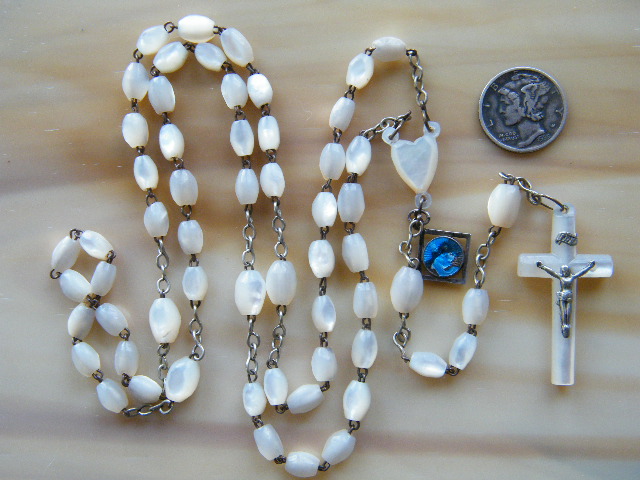
 Antique rosaries featuring mother of pearl beads have a delicate beauty as in this antique French MOP and gold gilt rosary from the beginning of the 20th century. It and the other rosaries featured can be found at The Sacred Bead. If you are thinking about buying an antique rosary, The Sacred Bead has one of the most extensive collections of beautiful antique rosaries in all price ranges on the internet!
 Lovely hand-cut mother of pearl beads show the reflective quality of natural shell. Note, both the center and crucifix are of mother of pearl.
 Very similar in style, but note the uniformity of the beads and difference in the style of chain- this is a slightly newer rosary than the one above.
 A true treasure-this beautiful antique rosary has a lovely shell case. Note the darker color of the shell used in this rosary and the unusual squared shape of the beads.
For millennium, people have made beads of shell. Some of the earliest beads found in archeological sites are drilled shell beads. The beauty and hardness of shell made it the perfect material for bead making. Mother of pearl, also called nacre, is from the shells of mollusks and is especially beautiful due to its iridescent reflectivity. The way it almost glows and changes appearance made it especially valued for not only beads but buttons, inlays in musical instruments and furniture and for many other decorative uses.
Cleaning mother of pearl rosaries should be done very carefully and with a minimum of product use. The only really safe thing is a gentle soap, not detergent, something like a bar of pure soap with a soft toothbrush is plenty. Wash your hands before touching mother of pearl or coral beads as the oils, lotions or other products can cause the beads to dull.
Antique rosaries from the 19th century were frequently made using mother of pearl beads. Some of the earlier rosaries used hand-cut beads, each of a slightly different shape and sometimes quite crude in appearance. Towards the end of the century and into the 20th century, most beads were much more uniform in appearance, many of them were machine cut. Sizes range from large beads, some over an inch in size for large processional rosaries, to tiny oval beads used on lovely antique rosaries with gold gilt or sterling silver metalwork. Some of the most beautiful rosaries have mother of pearl crucifixes and centers.


 Beautifully designed crucifix made of mother of pearl and silver above and a fabulous antique mother of pearl and silver, over 4" crucifix below. There were many faux MOP crucifixes made in the mid-20th century made of celluloid- meant to look like these authentic MOP crucifixes.


I will be adding many more antique French rosaries to The Sacred Bead in the coming month and many will have gorgeous antique MOP beads! Mother of pearl is one of my favorite natural materials, and the mysterious way it plays with light makes it a perfect material for meditative prayer.
I love answering questions about antique rosaries and will always answer them! Feel free to email me at The Sacred Bead. Visit the site and email from there please, you'll find a contact form and email links.

Tuesday, October 26, 2010

Coral Rosaries Antique and Modern

Nothing is more beautiful than a coral rosary with colorful beads from the sea. Long treasured for its health giving and mystical qualities, coral was highly prized during Victorian times and many lovely rosaries from this time, most of French origin, still exist today. Often one of the first gifts for an infant, coral was believed to protect the baby from harm. Although we seem to have lost this view of coral in the modern world, it is still strong in many cultures around the world. Protection from illness and the evil eye and other spiritual harms were its primary function. Now, we tend to love coral simply for its beauty. Shown below are two modern rosaries, using deep red dyed coral, and two lovely antique French rosaries with natural undyed coral.

The modern rosaries are made of sponge and bamboo corals, dyed to give the naturally white coral its color. There is nothing wrong with modern dyed coral, but it is important to be aware of the differences between antique natural coral and modern dyed coral.

Antique rosaries have natural Mediterranean coral beads, they are the natural color and are quite rare. The beauty of the coral is unsurpassed. Highly protected, natural red coral is expensive and precious today, even more so than in the past. Modern beadworkers and rosary makers generally use the dyed coral from the Pacific due to its availability and economy. The prices for modern dyed coral beads are just a fraction of what the price for authentic red coral would be. Because of its scarsity, natural red corals are both protected and products made from them regulated. Each country has laws regarding the importation of natural red coral and other natural corals.

Care should be taken when purchasing a coral rosary- be sure the seller knows if the beads are really coral. Many people are fooled by the glass and celluloid beads that were made to resemble coral. The colors were quite accurately reproduced, made specifically to look like the much more valuable coral. Looking at the beads with a hand lens lets you know if the beads are natural coral. Tiny growth lines are visible inside the coral, this is not visible in glass or celluloid. Many of the antique beads are also hand cut, especially the tiny ones common on rosaries. They will have a rounded, yet not perfect, shape.


The rosaries shown below are all available on The Sacred Bead. Look in the antique sections for authentic antique coral rosaries and in the designer section for modern coral.


The top two pictures are of a lovely modern, strung rosary using a deep red bamboo coral for the impressive beads.


The above two pictures are a modern rosary with beautifully dyed deep orange-red sponge coral.


This gorgeous rosary is a lovely Art Nouveau French rosary with natural Mediterranean coral beads in a lovely salmon color. Note the extra tiny medals on either side of the Pater beads, each has a profile of Jesus on one side and Mary on the other. This is a very rare and beautifully made rosary.  

Below is an early 20th century Art Deco natural coral rosary.