Sunday, March 27, 2011

Buying an Antique or Vintage Rosary - An Eco-Friendly Choice

For some of us, concern for the environment is a life-long commitment, for others it is an equally heart-felt but new concern. It doesn't matter where you are on this spectrum, the important thing is that purchasing an antique or vintage rosary really is an eco-friendly choice. It is a form of effective concept of recycling and reusing an item rather than buying something new. The Sacred Bead has a wonderful selection of antique rosaries for sale to help you pick the perfect rosary for yourself or a friend.
Just think, there is no mining, no manufacturing, only transportation via the postal service. It drastically reduces your carbon footprint! Not only do you save resource and energy, you have a piece of history and an exceptional work of art unlike anything produced today. The Sacred Bead has the largest selection of antique and vintage rosaries in one place on the internet! So come visit and be a part of the growing green consumer revolution. Our beautiful planet appreciates every effort. I try to use recycled packaging materials whenever possible so don't be surprised if your rosary comes in a peppermint candy tin or is wrapped with slightly used bubble wrap!
 Coral reefs around the world are dying at an alarming rate. Antique rosaries have beautiful natural Mediterranean coral unlike the dyed coral used today. Coral harvesting is now regulated and restricted by law, so buying an antique coral rosary is the most ecologically sound way to have a rosary made of this incredibly beautiful natural material. This rosary is in a private collection.
 Beautiful antique rosary with red glass beads from France.
 Very unusual 1800s rosary with sterling, mother of pearl and antique glass beads.
 Fabulous antique rosary with lapis lazuli beads. The lapis mines in Afghanistan have been mined for thousands of years and are reaching the end of their existence. Deep blue lapis like this is almost impossible to get new.
This is a gorgous vintage sterling and crystal Creed rosary, a fabulous example of a beautifully preserved vintage rosary by one of the leading rosary manufacturers in the world. See dozens of unique antique and vintage rosaries at The Sacred Bead.

Friday, March 25, 2011

Time for Another Warning About Rosaries with Added Skulls on eBay

I know I've already posted about the several sellers on eBay who have added modern carved ox bone skulls made in China to vintage and antique rosaries AND not been honest about saying they are modern additions, but after searching rosary + skull on eBay tonight I see the trend seems to be expanding. Before you ever buy an antique or vintage rosary with an attached skull, look at the seller's other items. If you see rosary after rosary with little skulls hanging off of them, all looking very much like the little skulls that are from modern Buddhist malas or ones found in online bead stores, then you should question the seller about the time period that the skull was added to the rosary. I've actually asked several sellers, receiving no reply from one and an admission from another that yes, she adds them. Unfortunately, without asking, you probably won't be told this in the auction.
None of this wouldn't matter IF people knew that the skull is not original to the rosary. Adding a skull bead that cost mere pennies does not increase the value of a rosary by a hundred or more dollars. Bidding is fierce on some of these rosaries and it really disturbs me that people are paying their hard earned money for something that is not authentic.
I make new rosaries using skull beads, so I am quite familiar with them. I also have quite a few rosaries with authentic antique skulls attached in my private collection. There is an enormous difference between the two. You can see my prior post from November, 2010 for pictures of authentic skull beads and how they are attached to the rosary- they are not dangling from them!
I am also seeing a trend in attaching a small, deep red tear drop shaped bead and selling these as antique rosaries with a drop of blood bead. Again, if you see the same dealer with numerous rosaries with the same bead, attached in the same way, it is a good clue that it is a recent addition.
When you have a favorite rosary, you can add whatever you like to it to help with meditative prayer. It is selling the rosary without informing the buyer that it is a modern addition that seems less than honest.

Saturday, March 19, 2011

Antique Rosaries With Mother of Pearl Beads

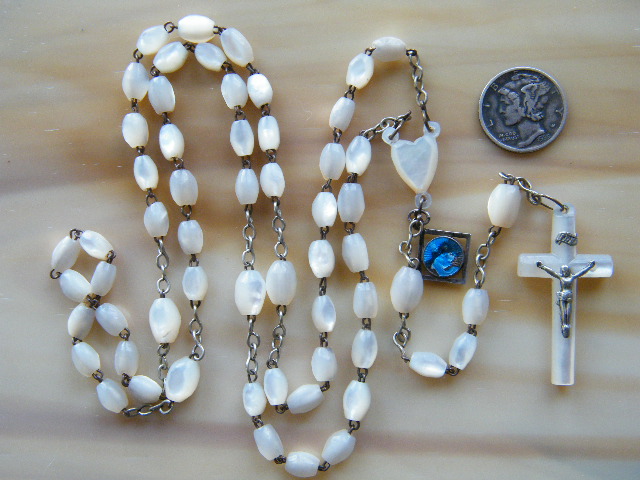
 Antique rosaries featuring mother of pearl beads have a delicate beauty as in this antique French MOP and gold gilt rosary from the beginning of the 20th century. It and the other rosaries featured can be found at The Sacred Bead. If you are thinking about buying an antique rosary, The Sacred Bead has one of the most extensive collections of beautiful antique rosaries in all price ranges on the internet!
 Lovely hand-cut mother of pearl beads show the reflective quality of natural shell. Note, both the center and crucifix are of mother of pearl.
 Very similar in style, but note the uniformity of the beads and difference in the style of chain- this is a slightly newer rosary than the one above.
 A true treasure-this beautiful antique rosary has a lovely shell case. Note the darker color of the shell used in this rosary and the unusual squared shape of the beads.
For millennium, people have made beads of shell. Some of the earliest beads found in archeological sites are drilled shell beads. The beauty and hardness of shell made it the perfect material for bead making. Mother of pearl, also called nacre, is from the shells of mollusks and is especially beautiful due to its iridescent reflectivity. The way it almost glows and changes appearance made it especially valued for not only beads but buttons, inlays in musical instruments and furniture and for many other decorative uses.
Cleaning mother of pearl rosaries should be done very carefully and with a minimum of product use. The only really safe thing is a gentle soap, not detergent, something like a bar of pure soap with a soft toothbrush is plenty. Wash your hands before touching mother of pearl or coral beads as the oils, lotions or other products can cause the beads to dull.
Antique rosaries from the 19th century were frequently made using mother of pearl beads. Some of the earlier rosaries used hand-cut beads, each of a slightly different shape and sometimes quite crude in appearance. Towards the end of the century and into the 20th century, most beads were much more uniform in appearance, many of them were machine cut. Sizes range from large beads, some over an inch in size for large processional rosaries, to tiny oval beads used on lovely antique rosaries with gold gilt or sterling silver metalwork. Some of the most beautiful rosaries have mother of pearl crucifixes and centers.


 Beautifully designed crucifix made of mother of pearl and silver above and a fabulous antique mother of pearl and silver, over 4" crucifix below. There were many faux MOP crucifixes made in the mid-20th century made of celluloid- meant to look like these authentic MOP crucifixes.


I will be adding many more antique French rosaries to The Sacred Bead in the coming month and many will have gorgeous antique MOP beads! Mother of pearl is one of my favorite natural materials, and the mysterious way it plays with light makes it a perfect material for meditative prayer.
I love answering questions about antique rosaries and will always answer them! Feel free to email me at The Sacred Bead. Visit the site and email from there please, you'll find a contact form and email links.

Saturday, February 19, 2011

Religious Medals on Antique Rosaries

Frequently, rosaries from the French influenced areas of Canada and throughout Europe have a variety of religious medals attached. Dating back centuries, the practice of attaching medals obtained during various religious pilgrimages proliferated in Europe and continues to today. Enjoy some pictures of antique rosaries with attached medals from Canada and Europe that are currently on The Sacred Bead. The Miraculous Medal is, without a doubt, the most commonly added medal found on rosaries.
Note the use of antique aluminum medals on this 15 decade antique rosary.
An Irish Horn rosary with an attached Miraculous Medal.
Art glass beads and a beautiful blue enamel medal of Mary grace this exquisite antique rosary.


An exceptional 15 decade rosary from a convent in Belgium. Note the carved skull bead on the rosary. Now in a private collection.
This incredible bronze medal of St. Franscis is on a Fransiscan Crown rosary also in a private collection.
Lovely crystal and sterling rosary with several pretty medals attached.

Wednesday, January 26, 2011

1950s Civelli Rosary

 
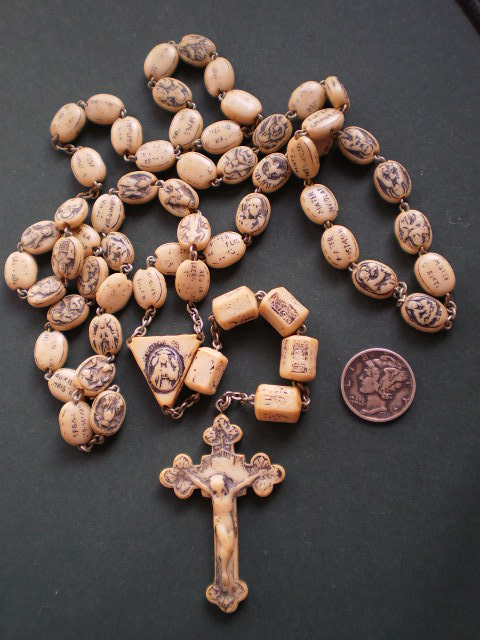
Here is a little history on the Civelli Rosary. There are several versions and different colorations but all were produced in the 1950's and designed by the Italian sculptor Civelli. They were made of "Ivorine" which is a plastic resin material similar to celluloid. One type of this rosary is the 1950's Civelli Rosary with Regina Pacis, Queen of Peace, center with relic soil from the Catacombs of Rome embedded in the reverse of the center. The beads portray the Litany of the Blessed Virgin and the Mysteries of the Holy Rosary. Latin inscriptions are on the reverse of each bead. The original tag "Made in Italy" and "Marque Depose" (Trade Marked) may be present on some rosaries. 

The first Civelli rosary is the famous Jubilee Year MCML (1950) Civelli Rosary. Originally designed by the famous Italian sculptor Civelli in the late 1940's for the 1950 Holy Year, this was the first issue of the rosary and has a center with the Holy Spirit and Anno Sancto (Holy Year) 1950 (in Roman Numerals MCML) on the reverse. The Civelli rosary is one of the few patented rosaries. 
 
These are incredibly beautiful rosaries, and are increasingly difficult to find. Although many have never been used, the ones that show wear from prayer are especially beautiful. The beads and crucifix  resemble ivory more and more as they age and are polished with touch.  I have rarely seen a broken Civelli rosary, so most are sturdy enough for continued daily use even though they are over 60 years old.


 The above Civelli rosary is somewhat worn from prayer and has a mellow aging that makes it even more lovely to behold. See it on The Sacred Bead.

Saturday, January 15, 2011

Antique French Hollow Sterling Rosary Crucifixes and Centers

Simply gorgeous silver work from the French in the later half of the 19th Century! These are delicate, hollow, and marked with the French punched hallmark. Find this beautiful rosaries on The Sacred Bead, your source for the finest antique and vintage rosaries.


 Exquisite work on this beautiful crucifix.
 Note the three dimensional center, what I call a puffy heart center. Lovely workmanship.


This is a more typical example of a hollow silver crucifix from the 1800s. If you ever have questions about antique rosaries, feel free to email me at The Sacred Bead's email. I happily answer all questions and have advised people from around the world about the antique rosaries they own!

Sunday, December 12, 2010

The 1800s Aluminum Story

Although aluminum is viewed as a cheap metal today, one that is virtually tossed away with the garbage, this hasn't always been the case. Collectors of antiques have some appreciation for the change in this metal's status over the centuries. Despite this, there is little market for aluminum objects, even those of superior workmanship and beauty.


If you read The Lost Symbol, you may have noticed the rather odd references to the high value of aluminum in the 1800s. This honestly was the case. Aluminum was a new and unique metal, durable, lightweight, and resistant to tarnishing. At the time, it was considered quite rare and valuable. The very top of the Washington Monument is overlaid in aluminum; it catches the sunlight and shines like silver. Although it is the most common element in the rocks of the earth, efficiently extracting it from the ore was puzzling and expensive, prohibiting its mining and use. Unlike silver and gold that occur in veins, aluminum is bonded to other elements in the rock, making extraction difficult.


For rosaries and religious medals, aluminum was highly prized during the late 1800s. Medals were lightweight and could be made with details not possible with other materials. Centers and crucifixes were made of aluminum in the late 1800s and early 1900s. Today they aren't appreciated, but at the time, their intricate details were considered the latest technology and were quite desirable. Many antique rosaries have aluminum medals attached; they were prized for their beauty.


Collectors of religious medals can get fantastic bargains if they branch into antique aluminum medals. Owners and collectors of antique rosaries can gain a new appreciation for the metal when they consider how impressive it was at the time the rosary was created.


I rarely have aluminum medals or rosaries on my website; I am aware of the prejudice against the metal and how it affects the choices collectors make. I'd like to see the day when it is recognized for its historic value and appreciated for the role it played in advancing the technology of 19th century religious artifacts.


 Sweet little French rosary with coral red glass beads. Below is a Pocket Saint with brass case, the statue of Mary and Child is aluminum. These were treasured by soldiers and travelers as they could be kept safely in a pocket.


The two medals attached to this lovely old Irish Horn rosary are both aluminum. Note the crisp detail on the medals. Available on The Sacred Bead.
 This is a lovely example of an antique French rosary with aluminum crucifix and art glass beads. It is quite a bargain on The Sacred Bead!

Tuesday, November 23, 2010

Antique Strung Rosaries

Although unfamiliar to the eyes of rosary users in the United States, antique strung rosaries are common in Europe and descended from the earliest of rosaries. Wiring a rosary didn't come into fashion until the 1700s so in the vast history of prayer beads, it is a rather modern development! The common 5decade rosary is frequently found strung in France, Belgium and Germany, but the most famous of the strung rosaries are the 5 and 6 decade rosaries from Bavaria with their gorgeous antique filigree silver crosses and Pater beads. Note the second cross above the main cross- this is the Credo Cross. Some of the main crosses have enamel on copper inserts, the oldest of these have wood and mother of pearl crosses in the center of the silver filigree. Because of the amount of use these rosaries got, the string would often break and need to be replaced. Sometimes beads were lost and replaced over the decades. This is just part of them being authentic antique rosaries.These are truly collector rosaries, yet are still produced in Bavaria and are exceptional in their beauty.
Fifteen decade antique strung rosaries can be found in France, often with wood or bone beads.


 This is a beautiful example of an antique Bavarian rosary. Several beads have been replace on this one and the string may be from the mid-1900s, but the rosary originated in the 1800s. This one is a six decade rosary, quite common with Bavarian Rosaries. Find original antique Bavarian rosaries at The Sacred Bead.
 Beautiful silver and enamel work highlight the main cross. Note the smaller Credo Cross.


 This is a simpler antique Bavarian rosary without the enameled inset in the cross.
 From the 1800s, this full 15 decade antique French rosary has bone beads and bone cross with a brass corpus. Lovely antique rosary, still intact after more than a century!


Sweet little Belgian strung rosary. I believe the beads on this one and the cross are celluloid or similar early man-made material. I just love the little bow that has been tied there for decades. Currently, this is the featured rosary on The Sacred Bead.

Tuesday, November 16, 2010

A Magnificent Givre Bead and Sterling Rosary


Without a doubt, this is one of the most fabulous rosaries I've had. Note the hand cut givre beads with a black core and clear outer layer. I believe these are Murano glass beads, made on the famous glass-making island of Murano Italy, renowned for its centuries of bead making. Along with the incredible beads, this large rosary has all sterling metal parts. Especially gorgeous is the large detailed crucifix and the lovely spacers on either side of the Pater beads. Each exquisite spacer is detailed with a rose and leaves. This is an exceptional antique rosary, beautiful and finely crafted. It would make a spectacular gift, to be treasured for a lifetime. This lovely rosary is from France, where some of the world's finest rosaries have been produced.


I never clean or polish rosaries, you will see that the silver has an antique patina. The new owner may polish or not depending on their tastes.
See this and all my other fine antique rosaries on The Sacred Bead, the largest source for antique, vintage, and designer rosaries on the internet!

Saturday, November 13, 2010

Skulls on Antique Rosaries


Many antique rosaries used by nuns and priests had a carved bone, wood, ivory or other material skull attached, a Momento Mori, a reminder that we are mortal. The top two photos are from a European rosary from a convent and the skull does not appear to be bone, rather I believe it is jet, a very light carbonaceous natural material similar to coal that was highly prized during the late 1800's and used in mourning jewelry. Most antique "jet" beads are actually French jet, which is just black glass, this is because jet was rare and costly. This skull seems to be either bog oak or jet. The second skull is attached to a 15 decade rosary from a convent in Belgium. This rosary is now in a private collection. Note that the skull is of wood. This is the way authentic skulls should appear on the rosary, they are almost always attached as part of the chain, not dangling to the side.


Please be aware that there seems to be a rash of modern inexpensive Chinese/Tibetan bone skulls being added to historic rosaries. I get too many questions asking about the authenticity of skulls that interested buyers see on auction sites and it bothers me a lot that people are being deceived, whether intentionally or not. Please ask sellers questions about the origin of the skull, was it added recently? I have several modern rosaries in the designer section at The Sacred Bead that are made of modern bone skull beads, but there is no deception intended, they are modern, I made the entire rosary and I am not trying to pass it off as antique.


I firmly believe that antique rosaries should be left as they were found unless you are keeping them solely for yourself and then you may do as you please of course! The problem with this deceptive practice- adding skulls and other items and not explaining that they are recent additions- is the new buyer generally pays more because of the skull, medal, or the most recent addition I've been seeing is a red bead resembling a drop of blood, and they are sometimes led to believe that it is an original part of the rosary, which it may not be. I feel very strongly that sellers should know their materials and clearly explain any recent replacement parts or additions, assuring that the buyer knows exactly what they are getting. 


These are, of course, exceptional examples of skulls, not all the authentic original skulls of of this quality, some are much more humble. Remember that it is certainly worth the small effort to ask a seller if the skull is a recent addition.

Monday, November 1, 2010

Antique WWI and WWII Rosaries for Soldiers


 Note that all the centers on the Antique WWI rosaries are the same. Each one has a profile of Mary on one side and Jesus carrying the cross on the reverse. Every single one of the rosaries has this center. The crucifix is entirely another story. They vary greatly, from wood crucifixes to simple brass ones.


Accurate histories of rosary types are very difficult to come by- there are few with general knowledge on this topic, as rosaries have only recently become collector items. Prior to modern times they were solely devotional objects, and these soldier's rosaries exemplify that. These were official issue rosaries during WWI. The story goes that so many were produced there were plenty remaining up until WWII. Made to be durable, they are constructed of "pull chain" designed metal balls. Nearly indestructible, they were carried by our soldiers to battle.


Because of their extreme durability, they make wonderful rosaries for daily use. I have seen similar versions coming from nun's estates. Perhaps they were given to an aunt or sister who was a nun by returning soldiers, or maybe some were intentionally made for convent use.


Currently, I have one that has an old field repair on The Sacred Bead. This one is very special, as it must have quite a story to tell. It needs to go to a WWI history buff or someone who appreciates the endurance and devotion that rosaries have had. They are not all shiny and new! Many of the antique rosaries on my website have had over a century of loving use and repairs. But, that is the only WWI rosary I have ever seen with a repair, testifying to their extreme durability.


Most of these rosaries are solid brass. A few have silver plating, these are said to be the ones reserved for the chaplains. Some are worn through the plating, again testifying to their endurance. With constant handling, the old patina on the brass is gently worn away and they begin to glow again. I never clean rosaries, leaving that to the new owner. Some like the original patina, others like a polished look. These are absolutely gorgeous when polished. Although I have seen some sellers claiming the silvered ones to be sterling, none are marked sterling and they were made after the laws went into affect that silver and gold must be marked. I doubt that there are any that are sterling, so beware of sellers claiming that one is solid silver. Testing silver only reveals the surface material so silver plate will test the same as solid silver unless a file mark is made through the plating- which of course, ruins the rosary.