Tuesday, October 26, 2010

Coral Rosaries Antique and Modern

Nothing is more beautiful than a coral rosary with colorful beads from the sea. Long treasured for its health giving and mystical qualities, coral was highly prized during Victorian times and many lovely rosaries from this time, most of French origin, still exist today. Often one of the first gifts for an infant, coral was believed to protect the baby from harm. Although we seem to have lost this view of coral in the modern world, it is still strong in many cultures around the world. Protection from illness and the evil eye and other spiritual harms were its primary function. Now, we tend to love coral simply for its beauty. Shown below are two modern rosaries, using deep red dyed coral, and two lovely antique French rosaries with natural undyed coral.

The modern rosaries are made of sponge and bamboo corals, dyed to give the naturally white coral its color. There is nothing wrong with modern dyed coral, but it is important to be aware of the differences between antique natural coral and modern dyed coral.

Antique rosaries have natural Mediterranean coral beads, they are the natural color and are quite rare. The beauty of the coral is unsurpassed. Highly protected, natural red coral is expensive and precious today, even more so than in the past. Modern beadworkers and rosary makers generally use the dyed coral from the Pacific due to its availability and economy. The prices for modern dyed coral beads are just a fraction of what the price for authentic red coral would be. Because of its scarsity, natural red corals are both protected and products made from them regulated. Each country has laws regarding the importation of natural red coral and other natural corals.

Care should be taken when purchasing a coral rosary- be sure the seller knows if the beads are really coral. Many people are fooled by the glass and celluloid beads that were made to resemble coral. The colors were quite accurately reproduced, made specifically to look like the much more valuable coral. Looking at the beads with a hand lens lets you know if the beads are natural coral. Tiny growth lines are visible inside the coral, this is not visible in glass or celluloid. Many of the antique beads are also hand cut, especially the tiny ones common on rosaries. They will have a rounded, yet not perfect, shape.


The rosaries shown below are all available on The Sacred Bead. Look in the antique sections for authentic antique coral rosaries and in the designer section for modern coral.


The top two pictures are of a lovely modern, strung rosary using a deep red bamboo coral for the impressive beads.


The above two pictures are a modern rosary with beautifully dyed deep orange-red sponge coral.


This gorgeous rosary is a lovely Art Nouveau French rosary with natural Mediterranean coral beads in a lovely salmon color. Note the extra tiny medals on either side of the Pater beads, each has a profile of Jesus on one side and Mary on the other. This is a very rare and beautifully made rosary.  

Below is an early 20th century Art Deco natural coral rosary. 

Saturday, September 4, 2010

Silver Rosaries, The Beauty of Precious Metals

Sterling silver rosaries are not only beautiful but highly collectible. From the first decade of the 20th century, US law required that all precious metals sold in the United States be marked for their silver purity. Markings such as 925 or Sterling are generally stamped into the metal itself. This is not always the case though as some rosaries and jewelry came with paper tags that are long gone. If you want to be 100% sure that the rosary is sterling, look for the stamp.
This can't be done though with antique rosaries over 100 years old as they generally were not marked. European silver may have complex hallmarks that can be found in books or websites devoted to silver hallmarks. The French used little punchmarks that sometimes are almost imperceptible and difficult to decipher. Look on the bail of French crucifixes for a little indentation- you may be able to see just that on the sterling and milk glass rosary pictured here- look hard between one o'clock and two o'clock on the bail and you can just see the little mark. There is another at three o'clock on the right bail of the center. These indicate the region of France where the rosary was made- if you can make out the punchmark! Other European silver may be marked with an 800 which is a little less pure than sterling which is 925, what we would call "coin silver." German markings are usually based on 16 units so you may see 13 or 14 indicating how many parts out of 16 are pure silver.
Silver plated rosaries that have been used often show a little of the metal beneath showing through- look for a hint of brass on the high spots where rubbing may have worn away the plating.
Many antique rosaries have had replacement crucifixes added over the years; sometimes the crucifix is silver but the center is bronze or brass. Knowing that a rosary is antique, it is generally not a detraction for there to be replacement parts- this just shows that the rosary was prayed upon and well loved.
You can find many beautiful sterling rosaries, antique and vintage on The Sacred Bead. Sterling and European coin silver have a gorgeous warmth when aged. I never polish rosaries that I sell, I always leave that to the discretion of the new owner. Try to avoid dipping antique silver as it may remove all the patina, use a gentle silver polish or just let the rosary start to glow again with use.

Thursday, September 2, 2010

Silver Filigree Rosaries, Fabulous Spanish Colonial Style

These rosaries are simply gorgeous! They can be found with agate beads, mother of pearl, cut glass, and other quality materials, or as in this one, the beads are also silver filigree. Unlike most rosaries, these usually have extra filigree spacer beads above the center. Note that the center is a beautiful stylized M with three dimensional crown. The style is southern European and most likely made in Spain, Italy, or a country with Spanish influence. Most of this style were made near the end of the 19th century during the Victorian Era. I have seen a more modern example, it is in the gallery section on The Sacred Bead, that had moonglow lucite beads dating it to the middle of the 20th century. This is one of the most beautiful of the antique rosaries. For the high end collector or to use on rare occasions- because of their age I don't recommend daily use. Silver is a little soft and the links can be weak. This fabulous rosary can be found on the Antiques page 18 at The Sacred Bead.

Friday, August 20, 2010

Exquisite Mid-1800s French Rosaries

Some of the most exquisite rosaries are from the period the French refer to as the Napoleon III Era. From 1848 to 1870, Napoleon III reigned and rosaries were produced using the highest quality materials. Lapis lazuli, mother of pearl, French opaline glass, banded agate and other beautiful natural materials were combined with sterling for stunning rosaries that have never been surpassed in beauty.  

The following is a serious collector rosary from The Sacred Bead. It can be found on page 11 of the antique section. Although it is approximately 150 years old it is in incredible condition and could be used for daily prayer.

From the mid-1800s, the time of Napoleon III in France and the Civil War in the United States, comes this spectacular rosary of real opaline crystal and sterling. This is an incredibly handsome rosary with the subtlety of the beads and the glow of sterling. Note the gorgeous center with Mary, Mother of God, on one side and the Crucifixion on the other. The beads and cross are translucent with a hint of yellow when held to the light. Large and impressive, the rosary measures over 23" when laid flat and the crucifix is 2", not including the bail. The cross is made of carved opaline with sterling corpus. This is the fabulous opaline glass during its most popular time period, 1850s-1860s. The previous owner of this rosary has kept it in immaculate condition. This is truly a fabulous treasure for the serious collector.
Update- this beautiful and rare rosary was stolen. Shame!


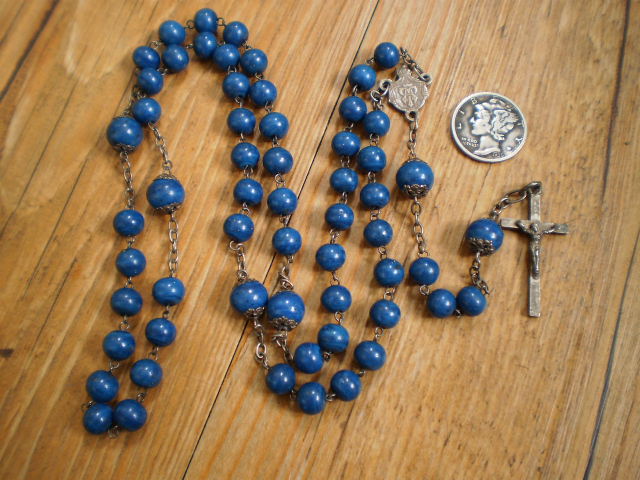
The beautiful rare lapis and sterling rosary from the mid-1800s is now in a private collection.


The opaline crystal and banded agate beaded rosary is another example from the same time period in my private collection.
 

Visions of Mary Our Lady of Salette

  Some of the most beautiful rosaries portray various apparitions of Mary. Although not as well known as the Apparition at Lourdes, Our Lady of Salette delivered an important message to two young children who had been tending their flocks in the French Alps.
This is a lovely antique French rosary of Our Lady of Salette, the village in the French Alps where Mary appeared to 2 children in 1846. Uniquely beautiful, this rosary has extra medals on either side of the Pater beads that depict ND de la Salette on both sides, one seated with her head in her hands and on the other, standing before the children. The most beautiful of French antique rosaries have these tiny extra medals making for an especially beautiful and meaningful rosary.The center has the same motif as the medals. Note the fleur de lis motif repeated on the crucifix, a famed symbol of France. The crucifix is marked on the reverse N D de la Salette. For those who don't know, N D stands for Notre Dame, Our Lady. Lovely pink art glass beads, most likely Czech in origin. The rosary is 21" when laid flat and quite calming in nature. 


This rosary can be purchased on The Sacred Bead, it is featured on page 16 in the Antique Rosaries section.